

Pope Leo XIV
Pope · 2025 – present
“We will now pray the Angelus together, that simple and beautiful prayer which helps us each day to live in faithful obedience to God’s will, following the example of the Virgin Mary.”
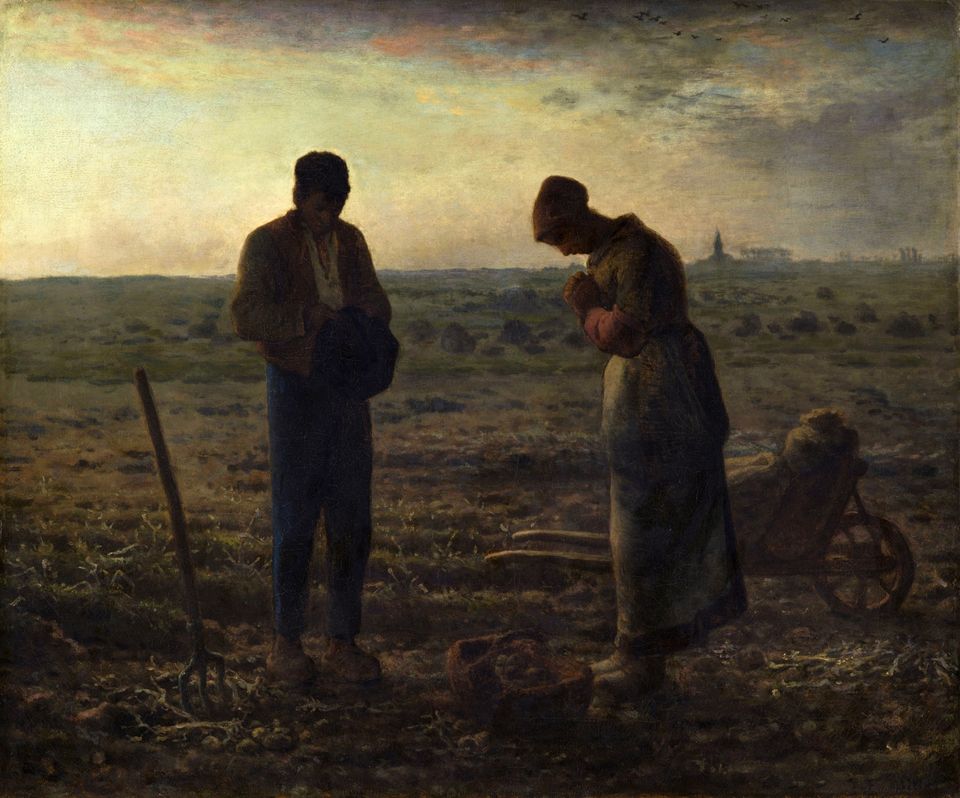
For more than seven centuries, popes have commended the Angelus and saints have stopped everything to pray it when the bell rang. Here are their words and their example, each with its source.

“Throughout the world, in homes and churches, in convents and seminaries, in fields and in cities, at work or at rest, many Christians pause at midday to pray the Angelus, to lift their minds and hearts for a few moments to the Lord, and to give thanks with the Mother of God for the mystery of the Incarnation.”


Seven centuries of popes have commended the Angelus. In our own day, the Pope leads it publicly every Sunday at noon.
Pope · 2025 – present
“We will now pray the Angelus together, that simple and beautiful prayer which helps us each day to live in faithful obedience to God’s will, following the example of the Virgin Mary.”
Pope · 2013 – 2025
“The Angelus prayer is a beautiful popular expression of the faith. … But it is an important prayer. I encourage each of you to recite it, along with the Hail Mary.”
“The Angelus prayer is a beautiful popular expression of the faith. It is a simple prayer, recited at three specific times during the day. It thus punctuates the rhythm of our daily activities: in the morning, at midday, and at sunset. But it is an important prayer. I encourage each of you to recite it, along with the Hail Mary. It reminds us of a luminous event which transformed history: the Incarnation, the moment when the Son of God became man in Jesus of Nazareth.”
“Today’s Liturgy offers us a beautiful phrase, that we always pray in the Angelus and which by itself reveals to us the meaning of Christmas. It says, “The Word became flesh and dwelt among us” (Jn 1:14).”
Pope · 2005 – 2013
“It is only right that the People of God, families and communities of consecrated persons, be faithful to this Marian prayer traditionally recited at sunrise, midday and sunset. … This practice can help us to grow in an authentic love for the mystery of the Incarnation.”
“The Synod also recommended that the faithful be encouraged to pray the Angelus. This prayer, simple yet profound, allows us “to commemorate daily the mystery of the Incarnate Word”. It is only right that the People of God, families and communities of consecrated persons, be faithful to this Marian prayer traditionally recited at sunrise, midday and sunset. In the Angelus we ask God to grant that, through Mary’s intercession, we may imitate her in doing his will and in welcoming his word into our lives. This practice can help us to grow in an authentic love for the mystery of the Incarnation.”
“Every day, praying the Angelus gives us the opportunity to meditate for a few moments, in the midst of all our activities, on the mystery of the Incarnation of the Son of God. At noon, when the first hours of the day are already beginning to weigh us down with fatigue, our availability and our generosity are renewed by the contemplation of Mary’s “yes”.”
“I would now like, however, to reflect on this amazing mystery of faith which we contemplate every day in the recitation of the Angelus.”
Pope and saint · 1978 – 2005
“Throughout the world, in homes and churches, in convents and seminaries, in fields and in cities, at work or at rest, many Christians pause at midday to pray the Angelus, to lift their minds and hearts for a few moments to the Lord, and to give thanks with the Mother of God for the mystery of the Incarnation.”
“It is this great mystery that we ponder each day in the Angelus: God became man in the womb of Mary.”
“This prayer takes its name from the Angel’s message to Mary: “Rejoice . . . the Lord is with you”.”
“So many bell towers announce three times a day the “Angelus”, the announcement made to Mary. It is so simple and so beautiful to repeat to her: “Hail Mary”. I will do it today with you, as I do personally every day; and every Sunday with the faithful who come to Rome.”
Pope and saint · 1963 – 1978
“What we have to say about the Angelus is meant to be only a simple but earnest exhortation to continue its traditional recitation wherever and whenever possible.”
“The Angelus does not need to be revised, because of its simple structure, its biblical character, its historical origin which links it to the prayer for peace and safety, and its quasi-liturgical rhythm which sanctifies different moments during the day, and because it reminds us of the Paschal Mystery...”
“These factors ensure that the Angelus despite the passing of centuries retains an unaltered value and an intact freshness.”
“And despite the changed conditions of the times, for the majority of people there remain unaltered the characteristic periods of the day-morning, noon and evening-which mark the periods of their activity and constitute an invitation to pause in prayer.”
Pope · 1939 – 1958
“Today the dangers that threaten your souls and the Catholic Church in your countries are no less. So when you hear the sound of the bells inviting you to prayer, remember this exhortation, and, with the same trust in God’s help, raise your pleading prayers to God as your forefathers did.”
“Before closing this letter We wish to remind you that Our predecessor Callixtus III, in the letter cited above, ordered that every day, in all the churches, the bells be rung at a set time, to move the faithful of the whole Catholic world to pray to Almighty God that, in His kindness and mercy, He would keep from the Christian people the terrible disaster that then hung over it. Today the dangers that threaten your souls and the Catholic Church in your countries are no less. So when you hear the sound of the bells inviting you to prayer, remember this exhortation, and, with the same trust in God’s help, raise your pleading prayers to God as your forefathers did.”
“A ‘fiat,’ an ardent ‘yes’ to the call to motherhood! … That is why, in praying the Angelus Domini, after recalling Mary’s acceptance, the faithful at once concludes: ‘And the Word was made flesh.’”
“As soon as she had heard the Angel’s message, Most Holy Mary replied: ‘Behold the handmaid of the Lord! Be it done to me according to your word’ (Lk 1:38). A ‘fiat,’ an ardent ‘yes’ to the call to motherhood! A virginal motherhood, beyond compare with any other; yet a real motherhood, in the true and proper sense of the word (cf. Gal 4:4). That is why, in praying the Angelus Domini, after recalling Mary’s acceptance, the faithful at once concludes: ‘And the Word was made flesh’ (Jn 1:14).”
“…a most favorable occasion to bring out the importance of the question and to express the wish that the faithful return to the use of this devout practice; that the ringing of its bells be restored where it had fallen into disuse, and introduced where it had never been in force; and finally to advise Catholics to use this prayer to implore God’s help for the needs of the Church…”
How the saints prayed it: on their knees in the street, at court, at table, in the garden.
Saint · 1581 – 1660
“St. Vincent de Paul, wherever he might be, or in whatever society, even at court, would recollect himself, and kneel down as soon as he heard the sound of the Angelus. … those who were present always followed his example.”
“St. Vincent de Paul, wherever he might be, or in whatever society, even at court, would recollect himself, and kneel down as soon as he heard the sound of the Angelus. He considered himself happy to be able to give public testimony of his filial love of the Most Holy Virgin Mary, and those who were present always followed his example.”
Saint · Archbishop of Milan · 1538 – 1584
“St. Charles Borromeo, who was so celebrated for piety and learning, was not ashamed, when Archbishop of Milan, to descend from his carriage or his horse in the open streets to recite the Angelus in honour of Mary.”
Saint · Doctor of the Church · 1696 – 1787
“As soon as he heard the sound of the bell, he went down on his knees, even when he happened to be in the public streets. When he became deaf he desired to be warned of the ringing of the bell …”
“He was most exact in the recital of the Angelus. As soon as he heard the sound of the bell, he went down on his knees, even when he happened to be in the public streets. When he became deaf he desired to be warned of the ringing of the bell, and even when at his meals he would break off and kneel down to recite it. Often was he rapt in ecstasy during this prayer from the fervour of his devotion.”
Saint · Curé of Ars · 1786 – 1859
“He was very exact in having them recite the Angelus, but for the Ave Maria of every hour, he left them free. If, when the Angelus rang, they continued to work, he would say to them: “There is a time to work and a time to pray.””
Saint · Capuchin friar · 1887 – 1968
“When the friary bell rang and he was able to recite the Angelus, either in the garden, or in church, or at his window, how passionate his voice was!”
Saint · Founder of Opus Dei · 1902 – 1975
“When we do this we discover the meaning of the Marian prayers, which the Church has always used, as if we were saying them for the very first time. What are the Hail Mary and the Angelus if not loving praises of her divine Motherhood?”
“After the reading of the mail, he would pray the Angelus at noon. It was an important moment in his day, because besides being a filial conversation with our Lady, it marked the time when his Eucharistic devotion changed its tone...”
Voices from parish and convent.
Priest · Exorcist
“One of the things we found the most effective in creating a good atmosphere within the home among the parents is if the parents get up and do the Angelus at 6 a.m., noon, and 6 p.m. ... There’s something about this that protects people in the spiritual warfare. We’re just now wrapping our minds around what specifically [makes this work]. Part of it just has to do with the discipline.”
“As exorcists, we’ve found that saying the Angelus at 6 am, noon, & 6 pm has the effect of keeping most people immune from diabolical influence. Doing it at 6 am, noon, & 6 pm develops spiritual discipline, & it has cleared out 90% of our caseload.”
Religious sister
“There is not a saint to be named, of recent centuries, who did not claim devotion to the Angelus.”
From the evening bell of the Franciscans to the noon Angelus in St. Peter’s Square.
St. Bonaventure tells his Franciscan friars to urge the faithful to pray three Hail Marys at the evening bell.
Pope John XXII approves the practice and grants an indulgence to those who keep it.

Pope Callixtus III asks that bells be rung at midday for prayer, the origin often given for the noon Angelus.

King Louis XI of France is credited with establishing the custom of praying the Angelus three times a day, at morning, noon and evening.
Pope Benedict XIII grants indulgences so that the faithful will pray it “not once only but many times a day.”

Pope Benedict XIV directs that the Regina Caeli be said in place of the Angelus during Paschaltide.

Jean-François Millet paints The Angelus, two peasants praying in a field at the sound of the evening bell.
Pope Pius XII, on the Assumption, in the Marian Year, prays the noon Angelus at Castel Gandolfo over Vatican Radio, the first papal Angelus ever broadcast. That autumn he begins praying it from his study window over St. Peter’s Square. Listen to the 1954 recording
At the order of Pope Pius XII, the Secretariat of State asks that the Angelus bell be restored where it had lapsed. That September, the Marian Congress at Lourdes votes that the bells ring again and that the faithful everywhere return to the Angelus.
Pope St. Paul VI, in Marialis Cultus, urges the faithful to keep praying the Angelus “wherever and whenever possible.”
Pope Benedict XVI, in Verbum Domini, asks families and communities to be faithful to the Angelus.
Pope Leo XIV, at Lourdes, calls the Angelus “that simple and beautiful prayer which helps us each day …”
Every Sunday at noon the Pope leads the Angelus with the pilgrims in St. Peter’s Square.
The same words the saints knelt to pray, at the same three hours.
Or let a real church bell remind you at 6, noon, and 6.
Every quote is word for word from the source linked under it. An ellipsis (…) marks words left out for length; “Read the full quote” shows the whole passage. Where a quote comes from a book, article, or post rather than an original document, the source line names it. Accounts of practice describe how a saint prayed; they are not the saint’s own words. Where no official English exists, we translate from the original and say so in the source line. Corrections are welcome at hello@angelusbell.org.