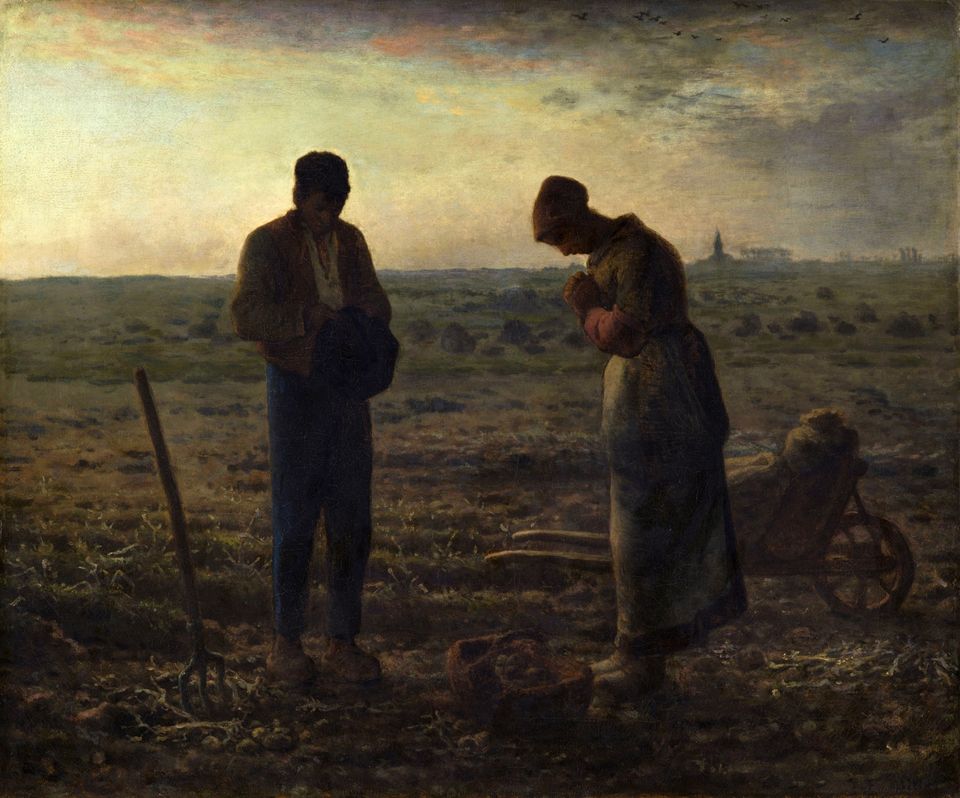
The Angelus is a traditional Catholic devotion commemorating the Incarnation of Christ. It is prayed three times daily, at 6 AM, noon, and 6 PM, when church bells ring to call the faithful to prayer.
V. The angel of the Lord declared unto Mary,
R. And she conceived of the Holy Ghost.
Hail Mary...
V. Behold the handmaid of the Lord;
R. Be it done unto me according to Thy word.
Hail Mary...
V. And the Word was made Flesh,
R. And dwelt among us.
Hail Mary...
V. Pray for us, O Holy Mother of God.
R. That we may be made worthy of the promises of Christ.
Let us pray: Pour forth, we beseech Thee, O Lord, Thy grace into our hearts; that we to whom the Incarnation of Christ Thy Son was made known by the message of an angel, may by His Passion and Cross be brought to the glory of His resurrection. Through the same Christ our Lord. Amen.
Latin
The official language of the Catholic Church
V. Angelus Domini nuntiavit Mariae,
R. Et concepit de Spiritu Sancto.
Ave Maria...
V. Ecce ancilla Domini,
R. Fiat mihi secundum verbum tuum.
Ave Maria...
V. Et verbum caro factum est,
R. Et habitavit in nobis.
Ave Maria...
V. Ora pro nobis, Sancta Dei Genetrix.
R. Ut digni efficiamur promissionibus Christi.
Oremus: Gratiam tuam, quaesumus, Domine, mentibus nostris infunde; ut qui, Angelo nuntiante, Christi Filii tui Incarnationem cognovimus, per Passionem ejus et Crucem ad Resurrectionis gloriam perducamur. Per eundem Christum Dominum nostrum. Amen.
During Paschaltide, from Easter Sunday until the Saturday after Pentecost, the Regina Caeli is prayed in place of the Angelus.
What the Angelus Is
The Angelus takes its name from the opening words of the Latin text: “Angelus Domini nuntiavit Mariae” (“The Angel of the Lord declared unto Mary”). This ancient devotion dates back to at least the 13th century and recalls the announcement of the Incarnation to the Blessed Virgin Mary.
Each of its first three verses and responses (marked V. and R.) recalls one moment of that mystery in the words of Scripture:
The Archangel Gabriel’s message. “The angel of the Lord declared unto Mary, and she conceived of the Holy Ghost” recalls the Annunciation (Luke 1:26–35).
Mary’s answer. “Behold the handmaid of the Lord; be it done unto me according to Thy word” are her own words to the Archangel Gabriel (Luke 1:38).
The Word made flesh. “And the Word was made Flesh, and dwelt among us” comes from the opening of St. John’s Gospel (John 1:14).
A Hail Mary follows each of the three. A fourth verse asks Mary’s prayers, and the closing prayer asks that we who have known the Incarnation through the Archangel Gabriel’s message may be brought, by Christ’s Passion and Cross, to the glory of His Resurrection.
“The Angelus does not need to be revised, because of its simple structure, its biblical character, its historical origin which links it to the prayer for peace and safety, and its quasi-liturgical rhythm which sanctifies different moments during the day, and because it reminds us of the Paschal Mystery...”
Traditionally, church bells ring at 6 AM, noon, and 6 PM to call the faithful to pause and pray the Angelus. This practice sanctifies the day, marking morning, midday, and evening with a moment of reflection on the mystery of God becoming man.
6 AMMorning
NoonMidday
6 PMEvening
How to Pray It
When the bell rings, pause what you are doing.
One person says each verse (V.) and everyone answers with the response (R.). If you are praying alone, say both.
After each of the first three verses and responses, pray one Hail Mary. In the prayer above, tap “Hail Mary…” to show the full text.
After the fourth verse and response, pray the closing prayer, which begins “Pour forth, we beseech Thee, O Lord.”
The whole prayer takes a minute or two. By long custom it is said kneeling, except on Saturday evening and on Sunday, when it is said standing.
History
The Angelus grew out of the medieval custom of greeting Our Lady with Hail Marys when the evening bell rang.
1262St. Bonaventure tells his Franciscan friars to urge the faithful to pray three Hail Marys at the evening bell.
1318Pope John XXII approves the practice and grants an indulgence to those who keep it.
1456Pope Callixtus III asks that bells be rung at midday for prayer, the origin often given for the noon Angelus.
1472King Louis XI of France is credited with establishing the custom of praying the Angelus three times a day, at morning, noon and evening.
1724Pope Benedict XIII grants indulgences so that the faithful will pray it “not once only but many times a day.”
1742Pope Benedict XIV directs that the Regina Caeli be said in place of the Angelus during Paschaltide.
1857–59Jean-François Millet paints The Angelus, two peasants praying in a field at the sound of the evening bell.
1954Pope Pius XII, on the Assumption, in the Marian Year, prays the noon Angelus at Castel Gandolfo over Vatican Radio, the first papal Angelus ever broadcast. That autumn he begins praying it from his study window over St. Peter’s Square. Listen to the 1954 recording
1958At the order of Pope Pius XII, the Secretariat of State asks that the Angelus bell be restored where it had lapsed. That September, the Marian Congress at Lourdes votes that the bells ring again and that the faithful everywhere return to the Angelus.
1974Pope St. Paul VI, in Marialis Cultus, urges the faithful to keep praying the Angelus “wherever and whenever possible.”
2010Pope Benedict XVI, in Verbum Domini, asks families and communities to be faithful to the Angelus.
2026Pope Leo XIV, at Lourdes, calls the Angelus “that simple and beautiful prayer which helps us each day …”
TodayEvery Sunday at noon the Pope leads the Angelus with the pilgrims in St. Peter’s Square.
Voices of the Church
“Throughout the world, in homes and churches, in convents and seminaries, in fields and in cities, at work or at rest, many Christians pause at midday to pray the Angelus, to lift their minds and hearts for a few moments to the Lord, and to give thanks with the Mother of God for the mystery of the Incarnation.”
“It is only right that the People of God, families and communities of consecrated persons, be faithful to this Marian prayer traditionally recited at sunrise, midday and sunset. … This practice can help us to grow in an authentic love for the mystery of the Incarnation.”
“As soon as he heard the sound of the bell, he went down on his knees, even when he happened to be in the public streets. When he became deaf he desired to be warned of the ringing of the bell …”
During the Easter season the Angelus is replaced by the Regina Caeli (“Queen of Heaven”), a joyful prayer celebrating the Resurrection of Our Lord. It is prayed from Easter Sunday until the Saturday after Pentecost.
Each translation is printed exactly as its source gives it. The source is named under the text.
Questions
What does “Angelus” mean?
It is the Latin word for “angel.” The prayer is named for its first words, Angelus Domini, “the angel of the Lord,” recalling the Archangel Gabriel’s announcement to Mary that she would conceive the Son of God.
When is the Angelus prayed?
At 6 AM, noon, and 6 PM. From Easter Sunday until the Saturday after Pentecost, the Regina Caeli is prayed instead.
How long does the Angelus take?
A minute or two.
Can I pray the Angelus alone?
Yes. When you pray it alone, say both the verses (V.) and the responses (R.).
Why is a bell rung for the Angelus?
The bell calls everyone within hearing to stop and pray at the same moment.
Is there an app that rings the Angelus?
Yes. The free Angelus Bell app rings a real church bell at 6 AM, noon, and 6 PM on iPhone, iPad, Apple Watch, Android, and Chrome. Get the app.
✦ ✦ ✦
Never Miss the Angelus
Our app brings this ancient devotion into your daily life with historic church bell recordings from around the world. Beautifully designed. Entirely free.